How I Teach William to Apologize Properly

When William turned four, I began noticing subtle shifts in his personality. He was no longer just my sweet toddler who followed me around the house.
He was becoming more independent, more opinionated, and much more aware of what other children had. That awareness, while completely normal, brought new parenting challenges I had not fully faced before.
One particular afternoon at Maplewood Community Park taught me more about apology and accountability than any parenting book ever could.
It was early May, around 4:15 p.m., warm but comfortable, probably about 74 degrees. I had picked William up from preschool, and as usual, we stopped by the park before heading home.
Maplewood Park has a wide open grassy field, a wooden climbing structure painted in deep green, and a sandbox area with two long benches facing each other. It is familiar to us.
That afternoon, several families were there. One mother sat reading on the bench while her daughter played quietly in the sandbox. That little girl caught William’s attention almost immediately.
The Girl With the Candy

Her name, I later learned, was Lily. She looked around four or five years old, slightly taller than William, with light brown hair pulled into two low ponytails secured with pink elastics.
She wore a pale pink windbreaker with small white daisies printed across it and denim leggings that had tiny star patches near the knees.
She was sitting on the bench beside her mother, carefully unwrapping a bright orange fruit chew candy.
I noticed the wrapper immediately because it made that crisp plastic sound children recognize instantly. It was one of those individually wrapped chewy candies, the kind that feels like treasure at that age.
Her mother leaned down and said, “Remember, you earned that after swimming lessons today.”
Lily smiled proudly and peeled the wrapper open slowly, as if savoring the moment.

William froze mid-step. He was holding a small plastic shovel in his hand, but his eyes locked onto that candy.
I saw the shift instantly. He walked toward her with quiet determination.
“Can I have one?” he asked.
Lily shook her head gently. “It’s mine.”
Her mother gave me a small polite smile, the kind parents exchange when they recognize a normal childhood boundary moment.
The Moment That Escalated
William stood still for a few seconds. I could see the disappointment register on his face. His eyebrows pulled together. His jaw tightened slightly.
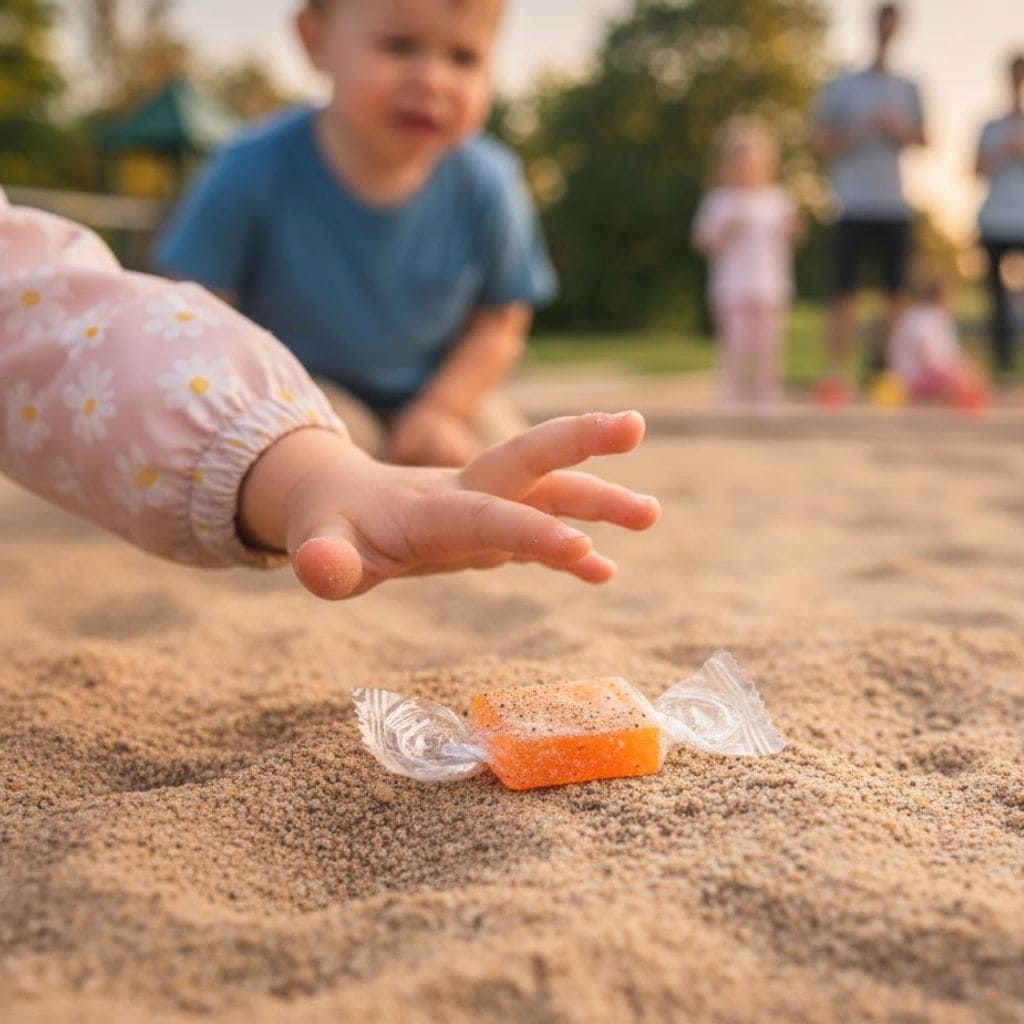
Instead of walking away, he reached forward quickly and grabbed the candy from her hand. It happened in less than two seconds.
The candy slipped from Lily’s fingers and fell directly into the sandbox. A thin layer of sand clung to its surface. She stared at it in shock before her lower lip began trembling. Then the tears came.
At that moment, I felt every eye on the playground shift toward us. I felt embarrassed, but more than that, I felt responsible.
Choosing My Response Carefully
I walked over immediately, but I did not raise my voice. I have learned that when emotions run high, calm leadership matters more than volume.
I knelt down so I was at William’s eye level.
“Look at Lily,” I said gently.
He glanced at her quickly, then looked away.
“What happened?” I asked him.
“She didn’t give me candy,” he said defensively.
“That’s true,” I replied calmly. “But whose candy was it?”
He hesitated before answering. “Hers.”
“And when you grabbed it, what happened to it?”
“It fell.”
“And how does she feel right now?”
He looked at her again. She was wiping tears with the sleeve of her jacket.
“Sad,” he whispered.
Teaching the Structure of a Real Apology
At that moment, I knew I did not want a rushed sorry just to end the situation. At four years old, he is capable of understanding more than we often assume.
So I told him quietly, “An apology has three parts.” He looked confused but listened carefully.
“First, you say exactly what you did. Second, you say how it made the other person feel. Third, you say what you will do next time.”
I guided him slowly. He turned toward Lily and said, “I grabbed your candy.”
His voice was small, but clear. “You felt sad because it was yours,” he added after I nodded encouragement.
“And next time?” I asked softly.
“I will ask and wait,” he said.
I then picked up the sandy candy and handed it back to Lily’s mother, apologizing as well.
I walked quickly to the small snack stand near the entrance of the park and bought a new fruit chew. When I returned, William handed it to Lily himself.
“I’m sorry,” he said again, this time making eye contact.
Lily accepted it, still slightly teary but calmer. Her mother smiled and thanked us for handling it thoughtfully.
The Conversation on the Way Home

On the drive home, I did not lecture him or repeat the mistake harshly. Instead, I asked him to tell me the story from beginning to end.
He explained that he wanted the candy very badly and felt angry when she said no.
I told him something important that I believe deeply: “Wanting something is normal. Taking it is not.”
We practiced sentences together.
“Can I have some?”
“It’s okay if you say no.”
“I will wait.”
Later that week, at the same park, another child had a toy truck William wanted. I watched carefully from a distance.
He walked over and said, “Can I try after you?”
The boy said, “Not yet.”
William paused for about three seconds. Then he nodded and walked back toward me.
Why I Believe in Teaching Apology This Way
Apology should not be about forcing politeness, it should be about building empathy and responsibility.
When a child understands what they did, how it affected someone else, and how to repair it, they build emotional intelligence.
Since that afternoon, I have noticed changes. When he accidentally bumps into me or knocks something over, he says, “I made a mistake. I will fix it.”
He is learning that actions have impact and that repair is possible.
That afternoon at Maplewood Park was uncomfortable. I felt judged for a few minutes, but it became one of the most meaningful parenting lessons I have experienced so far.
Teaching a child to apologize properly is not about avoiding embarrassment. It is about shaping character.